The Model Car Showroom
Reviews, pictures, hints, and links 1/24, 1/25 car kits
2004 Ferrari Enzo

This is a review of the Revell Ferrari Enzo Kit#85-2192
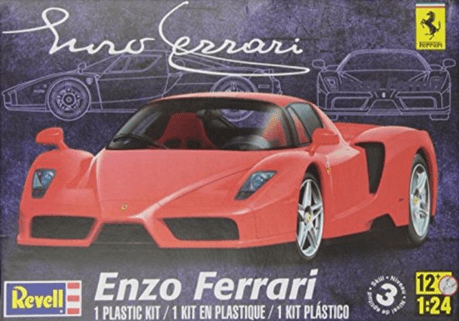
The Enzo is one of the newer Ferraris that I’ve come to really like, and it is more than the grandness of its namesake. This kit is one of the most difficult kits I’ve built for a number of reasons, but the end result is usually so good that I have made it 3 or so times.

Unlike some cars, the Enzo has been done in enough ways that you can truly pick your poison in terms of difficulty and detail. The snap kit is very plain and plastic-y looking; the Revell is difficult goodness, and the Fujimi is – from what I’ve seen in other kits – the peak of design and quality. For those who want it all, the Revell Ferrari pack includes three of the best Ferraris ever produced – the F50, the 360 Modena, and this Enzo.
UPDATE 10/2025 :: After conversing with a nice person about this kit/car, I’ve been made aware of another model kit made by Tamiya. When researching (which I don’t exhaust since there have been hundreds of thousands of kits built over the years) I didn’t see the Tamiya as it is RARE and expensive. For Europeans, the kit difference is closer to $40-50, but on this side of the pond, it is more like $100 or more, with long shipping waits if not found locally. The gentleman stresses this is the epitome of build goodness, but I can say wholeheartedly that the Revell kit is easily as good as one needs. I certainly like mine.

Also, like all good reviewers and builders, I can be made aware of my own mistakes and have revamped the kit’s rating to better reflect the kit, rather than the difficulty being a deciding factor. There are still drawbacks, but this is a good kit.
CAR BACKGROUND :: The idea was simple – build a car that is as good as Ferrari has made in its history. Yeah, easy. We’re talking about a company that has made the Testa Rossa (no, not the 1980s version), 250 GTO, Daytona, 512BB, 308, 288 GTO, and F40. There was a great deal of history to overtake.
Overtake them it did.
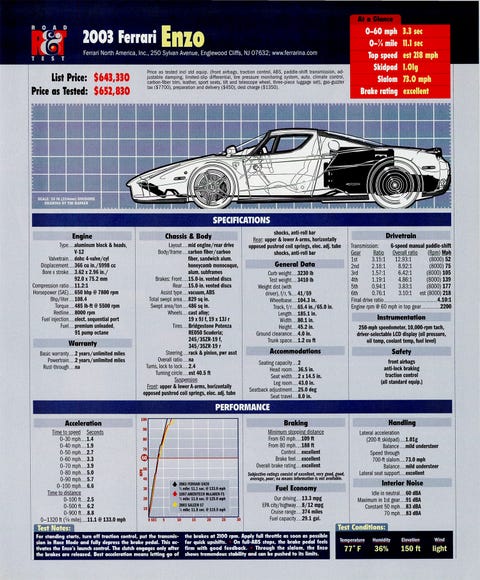
The Enzo and its 650hp became the quickest production car that year, and with its 218 mph top speed, it was amazingly fast as well. Granted, at well over the $650k listed on R&T’s sheet (because of dealer markups), it had enough coin thrown into it to possibly fly to Mars. It was more than the sum of its speed, however, as it contained more tech than just about any car to that point. Yes, it is a bit of a clod next to the LaFerrari, but in 2004, you’d have been hard-pressed to find something more tech-heavy and as fast. Today, it remains one of Ferrari’s greatest achievements and easily one of my favorite exotic cars. Awesome.
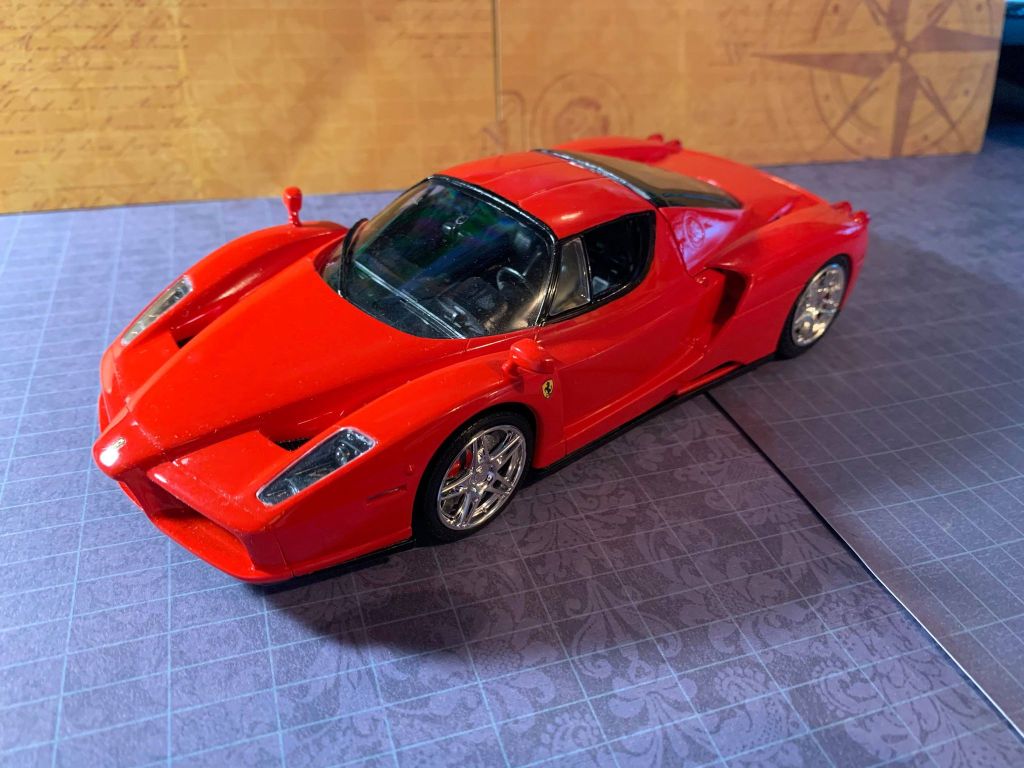
Tamiya Italian Red didn’t fail yet again and came out splendidly. The body has quite a few pieces you’ll want to attach before painting, so read the instructions first. There is also an amazing amount of glass that could ruin the build, so be extra careful not to over-glue the clear parts. Thankfully, the kit is amongst the cheapest in the model kingdom, but it still takes the wind out of sails to muff the glass while finishing up.
The most frustrating thing about this kit is the rear hatch. It fits nicely in some of these kits and atrociously in others. It is also a pain in the a$$ to bend into the correct shape as there are multiple merge points to the car body – so where one works well, the other is still off.
I didn’t bother too much with an interior pic because the Ferrari’s dash is sunk in, black, and the car has a window the size of a peanut. Safe to say it is a marvelous set of detailing – thanks to Revell.
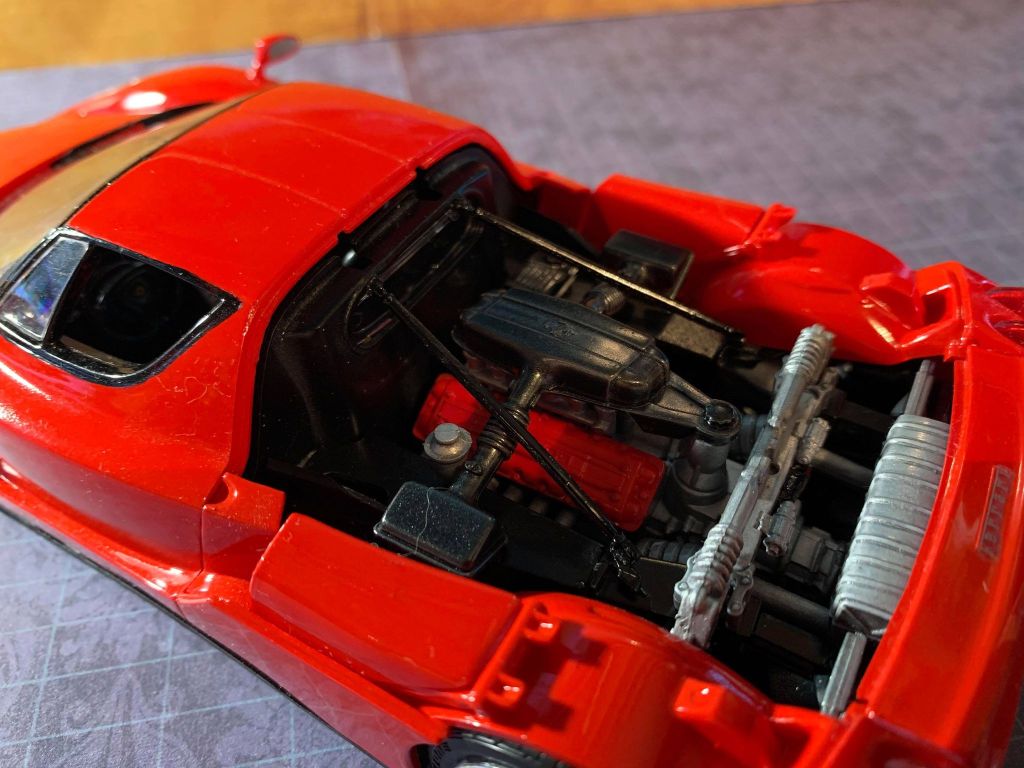
The engine bay is amazing. The V12 is super detailed, with dozens of parts to assemble. I’d not be surprised if there are as many here as some older Jo-Han kits’ full complement. It isn’t without its drawbacks, however. The exhaust is a futility in making corrections. The ports on the side of the block line up for the first piece, but the second piece is impossible to figure out, which makes the third piece even tougher for placement.
Thankfully, most of it isn’t showing, so you can fudge it together fairly well anyway, but it is NOT a good design. After you get it close, you then realize the damn thing is in the way of the motor mounts. If I ever want a yellow or white Enzo, this engine and chassis will be reused—guaranteed!
The underside of the Enzo is smooth and unimpressive. It is amazing to see a flat-bottomed car that isn’t a toy design, but it is just dull and flat black.
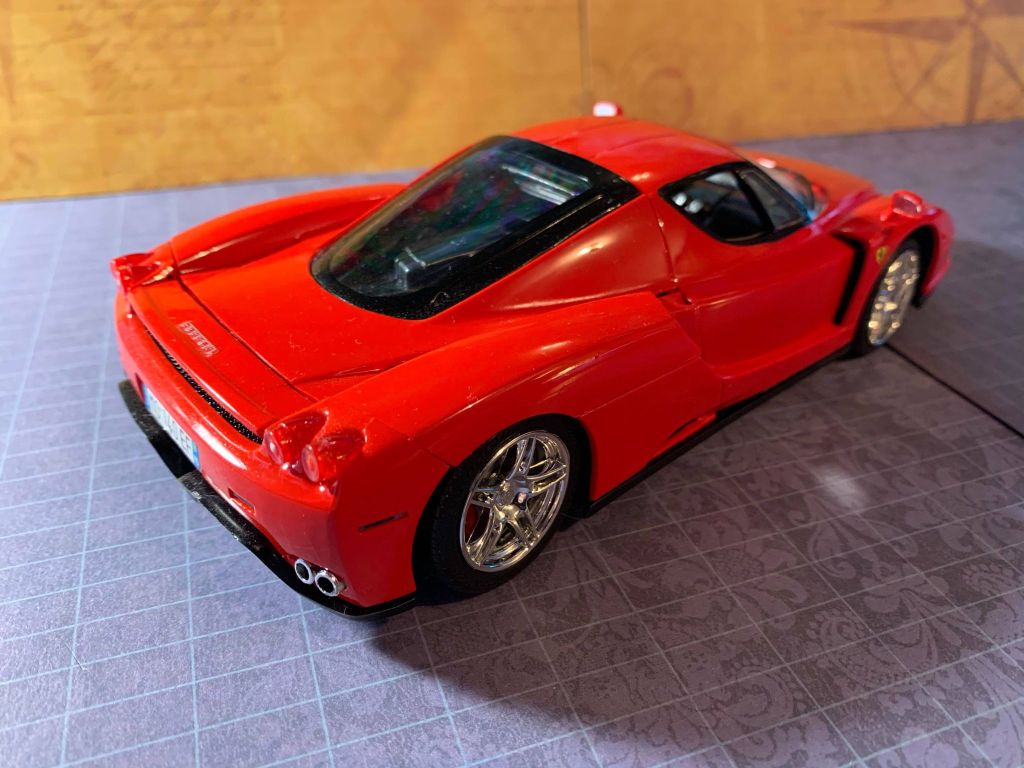
This is NOT a perfect model kit, but as I mentioned above, it is amazingly cheap. You can get 2 or 3 of these nowadays for the price of many other Ferrari kits. The hatch is a tough fit; the exhaust is tough to work out; there’s a good bit of glass to ruin; there’s a lot of black trim to do; and the mesh for the vents is a lesson in patience-breaking cut work. At roughly $11 a kit, however, you’ll have three or four to get it right!
8.25 Good
 The Model Car Showroom
Thanks for showing this but by far and away the best 1/24 kit of this is the Tamiya. It’s a piece of engineering genius and substantially better on every level that any of the others. It’s a heck of a challenge to build well but it will reward good and patient modellers with something way, way better than you have any right to expect of a modest priced, 1/24 scale plastic kit.
LikeLike
So, I appreciate the info and can imagine the Tamiya kit is one to be reckoned with. As good as the Revell kit is, I find it hard to believe the Tamiya Enzo is [THAT] much better to build AND that much better of a display comparatively in pricing. The Revell kit has very few flaws, has a TON of pieces, and is priced 1/8th of the Tamiya kit. That spells no-brainer for the average builder and can even be a coin-flip for the money-tight pro builder. Please send pics and I will do a followup article and fan submission. I’d love to see it.
LikeLike