The Model Car Showroom
Reviews, pictures, hints, and links 1/24, 1/25 car kits
’75 Dodge Dart Sport
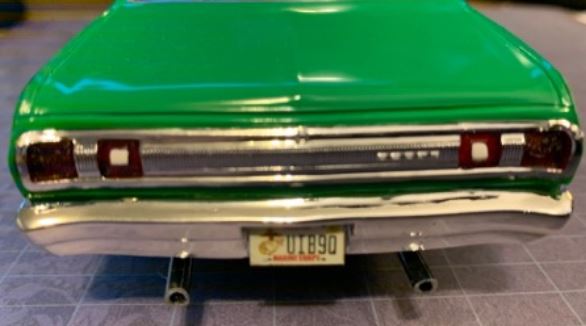
This is a review of the MPC 1975 Dodge Dart Sport #M798M-200

Well, here we are again. A MPC (pretty AMT) with much missing and some annoying qualities. It IS one of my favorite body styles which started with the 1970 Duster, and died with the less-than-spectacular Aspen. I had done this model before – the blue AMT one below – and had reasonable success, but I really wanted to do justice to this car.
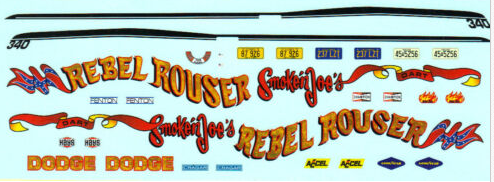
So, a quick thing about this model before going further. These wonderful decals are somewhat of a fraud. The car comes with a 360ci V8 (typical), and a 426 Hemi (not available in ’75). The air cleaner decal IS a 360 4-barrel, but there is nothing about the Hemi. Then there are the stripes… a 340 copy from the ’71 Duster kit. This car doesn’t have… nor came with a 340, AND there is no 340ci air cleaner decal, just the 360. Hmmph…

I have only made the blue one of these and the red is getting more and more pricey. They should all be around the same quality and include the same parts. The two here, however, have the crazy tunnel-rammed hood that you cannot get with the kit I did (though I also think that they are either attachable or you get a stock hood – so no worries if you think it daft!). They are also somewhat of a sham themselves, however. They both taut the name Duster in bold lettering, but if you look at the grille, D O D G E is clearly stamped across the front. That aside, you can still make handsome Dart models of these both.

CAR BACKGROUND :: Like so many cars in the mid-seventies, the Dart was going through “slowing-pains” to say the least, and it was becoming more and more just a commuting vehicle than a road rocket. Your best bet for 1975 was to order the 360 Sport with 230hp. The ominous 440 was reduced to a lethargic 215hp and weighed more than the small block. The 360ci Dart would most likely run the quarter mile in the high 15s – barely hitting 90mph. The days of stoplight drags were becoming myth and fantasy.
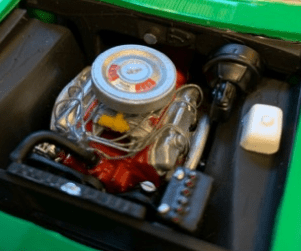
So, I thought I’d start with the engine bay since this one is a bit of a Frankenstein’s monster. The 360, though a nice engine, is very commonplace. It is also vastly under-powered for 1975. Thus the installation of a ’69 440 4-barrel. This engine, not only was available for ’75, but fits rather well. The remainder of this MPC’s engine bay is rubbish without help. The radiator is poorly detailed, there is NO master cylinder/brake boost, the firewall is incomplete and has little on it, and the battery has no “ledge” to rest on. Overall, the additions and fixes I’ve done has made this very palatable.
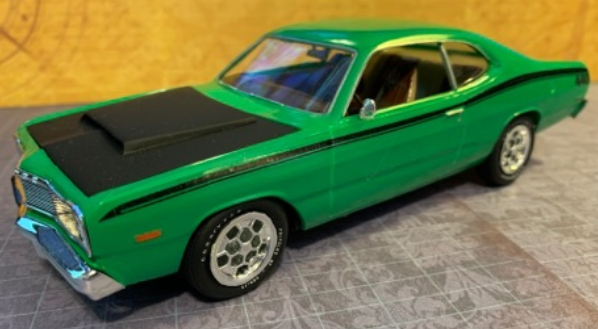
I decided to do this car in a rallye green motif, and even though it wasn’t a true ’75 color, I thought it looked right. It is Tamiya Park Green and it is a fantastic paint. I then went with the flat black (fiberglass) hood, the stock hubs, and used the nice white-letter tires that were included. I also made “440” numbers to go with the stripes. I cut the “360” and added the “440” to match the engine. I added a hood scoop off another kit (as the one provided is a BIT over the top), and a side mirror off a late-60’s Mopar since the ones that come with it are awful (the same generic ones as at least THREE other kits). I think I like this one as much as any I’ve made, but it is still a mess of a model kit (more to follow).
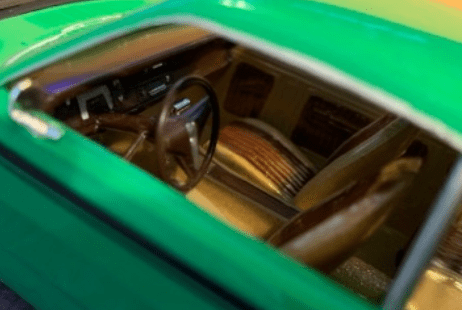
The Dodge’s interior is about as good as you’ll find with MPC/AMT models, but I wanted to really spice this one up. I went with a beige interior with brown accents and it really shows up well. I added a directional stalk, but it otherwise has a lot of good detail/parts.
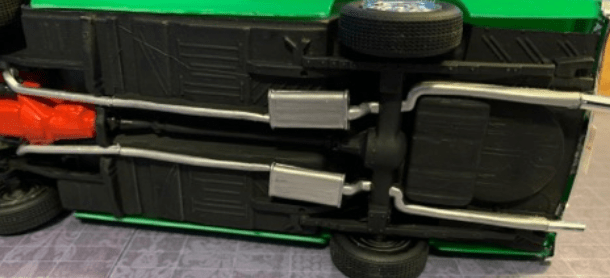
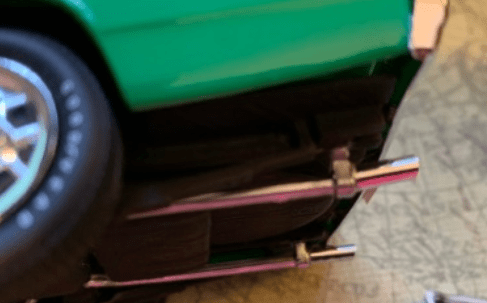
Even with the exhaust being fused to the under-carriage, this isn’t a bad looking area of the car. I had to use some exhaust pieces to link the 440 to the rest of the exhaust, but it was really easy to do and – with headers – would be potentially easier. The axle-back pipes are a bit on the thick side and where they are attached, look kind of silly. They would probably be 5″ pipes with the size of them and if I hadn’t paid as much for the kit as I did, I might have cut them off and added new exhaust, but I didn’t want to chance ruining the bottom of the car. I also chopped off the turn-down tips and added chrome tips. The stock ones are far too oversized.
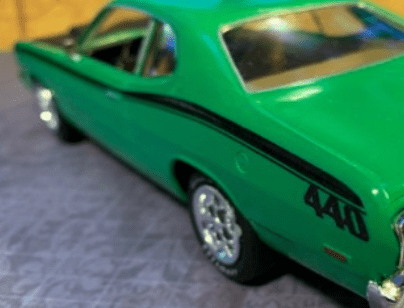
Liking this car and loving the finished product does not save it from being a pathetic kit. The stripes are fraud, the engine bay is abysmal, the missing pieces make for scrounging, and the “street rod” pieces are laughable. If you have patience and some know-how, you can certainly make this car into something terrific, but otherwise it is a flop. As far as being an investor car, the model was just reissued. However, there weren’t many “runs” of this car so they should become more valuable over a short time. It used to be for sale at Hobby Lobby, but has since been taken off the shelves. You can still find it for around $25-$30, though, so it is not “expensive”. It IS, however, a much larger cost when you consider the edits needed to make it right!
6.75 – Mediocre

UPDATE :: The exhaust was driving me nuts, so I cut it out. I didn’t realize it wasn’t part of the undercarriage, so it was an easy remove. I used the rear exhaust off of a ’69 440 Coronet kit and it looks a TON better! I very highly recommend replacing the axle-back pipes as soon as you start the kit. It really displays better and looks more realistic.
Five model kits to avoid like the plague! Or not?
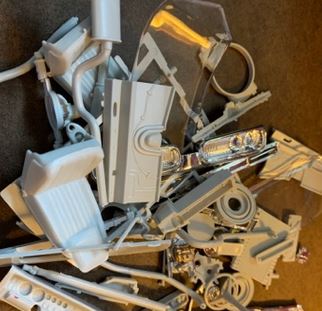
As model builders, we’ve all had times where we’ve looked at the model kit and thought – “that is gonna be awesome” – only to be disgusted with the build later on. Well, here is a small list (probably one of many to come) of models that are HIGH on my do-not-buy list. There are in no numeric order, but are a must pass… I think?
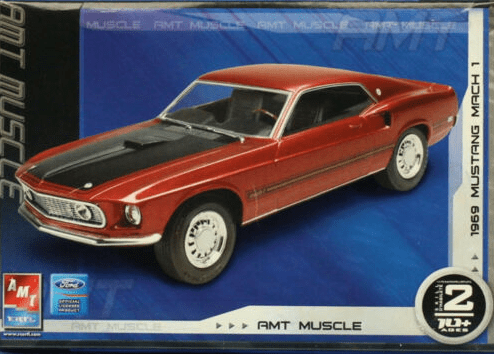
#5 — AMT Ford Mustang Mach 1
This is one of the worst kits I’ve ever built… and when I say built, I really mean “put together in the best way possible, only to throw it away soon aft”. And there is a lot of reason to hate this one. The suspension is rubbish; the plastic is very cheap feeling; there is more flash than needed; the engine is small for the engine bay; the mach one scoop/shaker doesn’t work with the hood; and the decals, IMHO, are terrible. It was like they had ZERO quality management in the production of this one and it shows with each step.
OPTIONS : Revell makes a 69 Mach 1, but it can be pricey. It IS worth the extra to buy it, however. You can also buy the Revell Boss 302 which is very similar to the Mach 1 CHEAPLY at Hobby Lobby.
INVESTMENT : This one has been around for a while, but it does have a few iterations, so for now, it is only a medium level investment. However, it is a better investment than a build by leaps and bounds!
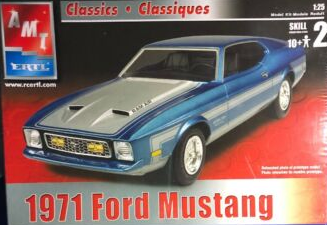
#4 – AMT 1971 Ford Mustang
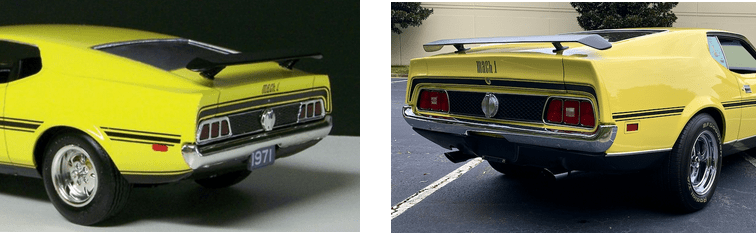
Mustang again, huh? Yup. This one is truly an abomination. I’ll start by saying that the front end is all wrong. If you look at the pics below, the light housing looks more like a ’73 (left) and so does the grille shape, while the directionals look like the ’71. The grille is also too small; disproportionate to the directionals; and the symbol isn’t quite right.
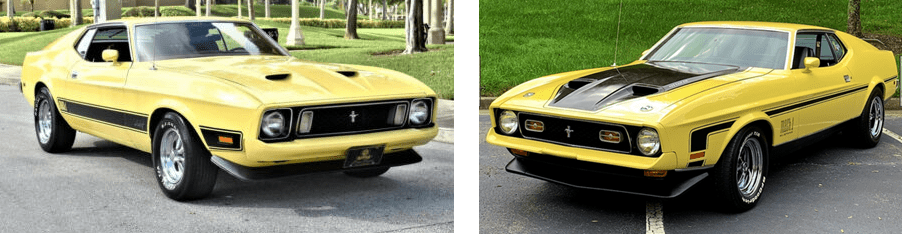
Add to that an engine bay that is a cavernous hole with the small block; a poorly detailed interior; and an awful decal set, and you have a model that isn’t worth the price to advertise it. All of this would be enough, but the rear taillights and grille setup (yeah, the 71-73 Mustangs had a “grille” of sorts in the rear) is also oddly shaped, positioned incorrectly, and flat-out ugly to look at. About the only good thing about this one is that there aren’t many ’71-’73 model kits out there (Revell has none). That said, it is also a shame not to have a better example of this killer ‘Stang.
Options : Really… none. The ’73 made by MPC/AMT has front issues too and the rear-end is just as bad (see pics below) – the valance is too thin; the lights aren’t curved enough; and the gas cap looks as big as the taillights (give credit to Randy for making the best – and best I’ve seen – of this garbage model kit). There just aren’t any others to find out there. I would give good money for anyone who knows of a spot-on kit for the ’71-’73 Mustangs.
Investment : Well, the fact that it is a sham of a car means nothing to non-auto enthusiasts, so the ’71s becoming more and more scarce should make for an “ok” investment. The ’73s were just reissued recently and unfortunately they didn’t change any of the problems with the poor design quality – so not a good investment either.
#3 – Revell 1968 Pontiac Firebird 400
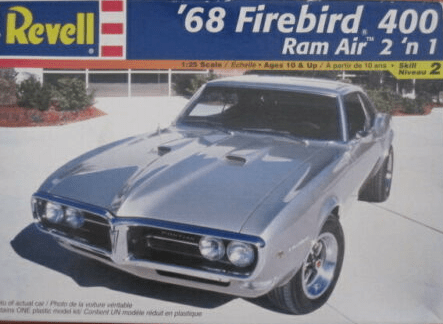
You will not find too many Revell model kits on my list of “not-buys”, but this is one I’d stay clear of if possible. The biggest reason is the rear taillights. They are shaped COMPLETELY wrong for the scale and I’ve tried to get it right for years with no luck. They made the holes so they have to be trimmed to fit the red inserts and when done, they are just TOO big for the rear panel. On top of that, I’ve had problems with missing pieces (on open kits), hoods with improper fit, rims being too small, and overall quality. It is a shame as there are few Firebird kits to choose from anymore, and this is a heck of a car IRL.
Options : There aren’t any. If you want a model of this car, you are stuck with this “fair” kit. I’ve seen worse, but it really doesn’t look right when done. I’d recommend the 1969 AMT Firebird over this one for an authentic look.
Investment : Giant win here. There just aren’t that many left AND there are only 2 or so versions produced. Right now they are $25 or better and I’d wager they’d be in the $40s or more in the next 5 years (unless there is a reissue). They are just that rare.

#2 – AMT 1971 Plymouth Duster Street Machine
This one is a bit different than the other kits. The kit itself is a relatively good facsimile of the 1971 Duster 340 kit made by AMT. However, this kit has a fun surprise to it. Most “street machine” kits have add-ons to stock pieces, but for the most part, you can build the stock vehicle. This one does not. It has a 488ci Dodge Viper motor, Viper rims (which look terrible), 90’s era tires (which look truck-like), and so on. This is a FUN kit if you are looking for something different and super custom, but for stock… this is a lemon.
Options : Obviously just buy one of 4 AMT ’71 Duster 340 kits. They are everywhere and at reasonable prices (Hobby Lobby will sell ya one for $18 with coupon).
Investment : The good news for this one is that I believe it is a great collector item. There aren’t many of them and they made only one “run” of them. I can’t see them not being collector items in the future.
#1 – AMT 1963 Chevrolet Corvette Stingray
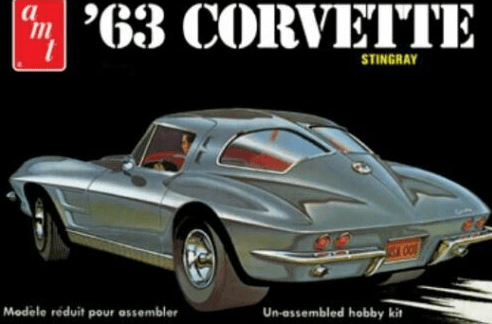
This one is a piece of crap in sheep’s clothing. One of THE most coveted Vettes in history, the ’63 split-window, is a gorgeously awesome ride. This is NOT an gorgeously awesome model kit, however. The one above, a recent reissue, is worse than the original. The plastic is cheap, full of ruts and flash, and its overall fit and finish is near bottom rung. I’ve had issues with the chrome, the wheels, the tires, and the glass too.
Options : My choice was to buy the 1965 non-split-window with the 396ci V8. It is NOT as cool, but because it is a Monogram, it is a really decent kit. The ’67 427 coupe by Revell is also fantastic. The AMT ’63 Convertible is a shade better, but not by a mile. It seems to have a few less flaws with glass fit and finish and has easier overall fit. If you HAVE to have a great copy of this year, you may want to look for a dealer promo or a die cast.
Investment : POOR. They just reissued this car recently and they are like spiders in Australia – EVERYWHERE. Between the poor quality and numbers, it just isn’t good right now. What it IS, is a super cheap build if you need one.
So there you have em… five kits I think you can stay away from building. Some ARE good investments, but I think they are terrible builds – such that they will not been seen on here. I have other kits I’ll mention in the future and I’ll be posting other reviews for kits that ARE terrible, but are good enough to build just the same.
Comments or questions, just let me know!
— kEVIN
’67 Mercury Comet Cyclone
This is a review of the AMT ’67 Mercury Comet Cyclone #6750

This is one of those models that I LOVE to hate. It is a car of small infamy and yet it is a design I’ve always been enamored with (more later). I have tried to build this one a couple times lately, but with issues with screwing up glass-fit and bad luck with paints, this has become a personal victory to finally finish it. My last successful one was years ago… it was red… and it was not that impressive. Times have changed a bit.

I have seen all the above kits – save for the drag looking antique kit. The remainder of them are of the same quality and piece-count as the one I did. And.. aside from the obvious drag version, I don’t think the others had a great deal of “speed” options.

CAR BACKGROUND :: So… my “like” for this car actually is a fraud. I owned a black version of this hot wheels car (pic left) when I was little. It actually is a Mercury Monterey that was thinner than it should be – thus looking more like the Comet. That said, I like the front end of the Comet anyways since I am a Galaxie/Fairlane fan. In some ways, the Comet was better than both in speed as well. The Comet with the 390ci V8 was faster than a Galaxie 500 (mostly due to heft) and – with the tests I’ve seen – was even a tic faster than the similarly optioned Fairlane. It’s numbers are low 15s at almost 95mph. Not blistering, but still relatively quick. However, sales-wise, the Comet and Fairlane did not fare well against the GTOs and 442s of the time. I like an underdog though!

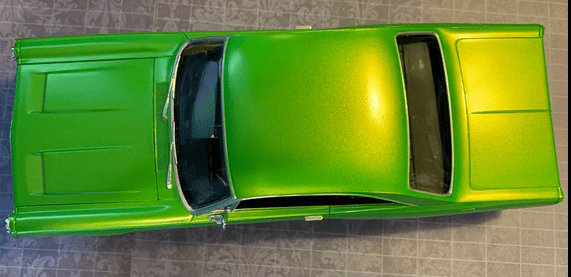
Well…, here she is. I went completely away from the horrifying blue and dreadful red I’ve used and went with a Lime Ice. This is a bit brighter than the Lime Frost color of the year, but it is close enough for me. There are fitting problems all over the place for this model, but it came out just right this time. Would’ve liked to have a black “GT” stripe on the wheelbase, but the decals were ruined in my kit. C’est la vie.

The first of the fitting issues comes at the hands of the interior. The dash, doors, and tub are all fit together, and THEN to the under-carriage. This means the entire unit has to be fit into the body tightly – with the hood matching, the rear bumper fitting, and the interior sitting in the right place. It isn’t impossible, but it is a pain to get all aspects right. Add to that further underside issues and it is a LOT of work. The interior is very deatiled, however, and looks sharp when finished. I forgot to do a two-tone on either this or the Fairlane, so I may re-do one one of them to further accent the interiors. They are top-10 best by AMT (I know.. not saying much, but still..) and are very easy to get right.

The engine bay is also one of the better AMT ones made. The engine is a nicely detailed 390; has a lot of surround detail; nice battery; separate master cylinder; and is framed well. Aside from a boring (but stock) air cleaner, I have zero gripes with this one. And, like I said above, you will not find many AMT engine bays this well laid out AND well detailed.

This is also a decent place to be for an AMT model. The underside has “ok” detail, an easy fitting exhaust, and tight fitting tires. The exhaust tips are boring (replaced), the rims could be better quality, and the front axle pins are in a bad placement (They are either too high one way, or too low the other – i.e. jacked in the rear or almost a “fuelie” look in the front). I fixed this one’s front end so the look is very stock, but it is a tricky placement nonetheless. Not perfect, but not a fiasco either.
Being one of the better AMT kits does not make for being one of the best muscle cars of the day. Unfortunately, the Comet has the same fame issues like that of the Galaxie and even the Fairlanes of the time and are often “after-thoughts” when in the same pool as Camaros and GTOs. I really like this car, this model, and this build. These kits are still quite plentiful and are still at a reasonable price (between $18 and $28). Can’t say it is a good investment because of its notoriety, but it is a heck of an AMT build.

8.5 – Good
2020 Contest Cancelled
Hiya,
Well…, I figured that there may be a better response to leaving comments or contacting me by offering free merchandise, but that has backfired. Not ONE comment or message has been offered, so I am therefore closing the contest.
— kEVIN
’71 Plymouth Barracuda Hemi
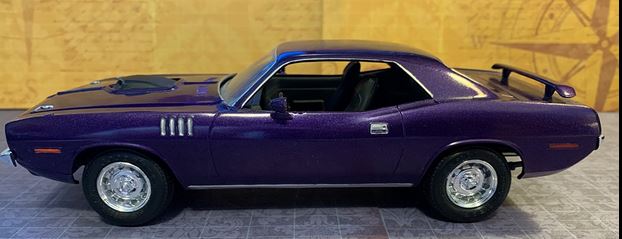
This is a review of the Revell 1971 Plymouth Cuda kit#2943

I have NEVER understood the absolute love affair most car fans have for the ‘Cuda. I don’t know if it is the name, the look, the Hemi, or just “because”, but I have never understood most enthusiasts’ infatuation with the fishy sprinter. Biggest reason for my impartiality is that there are a handful of muscle car Mopars that have the same 426 Hemi and run the same ¼mile in the mid 13s, so it really boils down to to each their own… but that’s just me.

Because there is such a crazed liking for this car, there are a ridiculous amount of models to choose from. The above kits all have differing features – shaker hood, convertible, street parts, etc, and all have the ominous Hemi. There are more than the above and they have most of the same quality as Revell and Monogram are both typically good. You have to watch for molded-in-color versions, but little else.
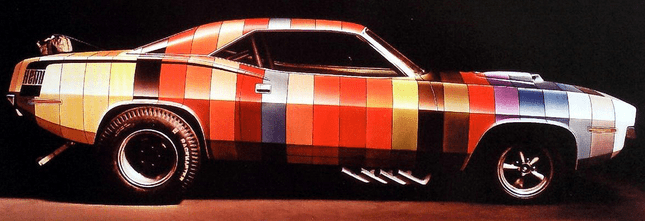
CAR BACKGROUND :: The Barracuda had already been around for years and some had made large statements about being muscular, but none had quite the impact as the ’70 and ’71 ‘Cudas. The above chart-car gives a rainbow-rific idea to how many choices there were. Once you found that “snazzy” color, all you had to do was pick which mill to pair it with. Most chose lesser engines, but the ones that opted for the 426 and 440 V8s had one of the top 5 fastest muscle cars of the day. At 13.4 and 106mph (some Hemi tests say 13.2, some say 13.7… I split the differences), there was almost nothing out there that could match it. Granted, like I said above, most Hemi Mopars ran close to the mid-13 mark, but the crazy color paint and shaker hood really captured the imagination of the car world more than any other. Don’t believe me? Just check the price tags of Mopar Hemis out there and you’ll almost always see a ‘Cuda at the top of the list.

BUILD NOTES : Does the model live up to the hype, then? Well, mostly. The bumpers can be a tricky fit; the shaker is tough to get just right to fit in the hole; The exhaust is part of the bottom and is a tight fit through the rear panel; and that grille… UGH. But.., being a tough kit doesn’t make it a lousy build… just a tougher one. Side note – if you want a “street” setup, you’d better buy the one that says it is, otherwise there are very few aftermarket parts for this one.

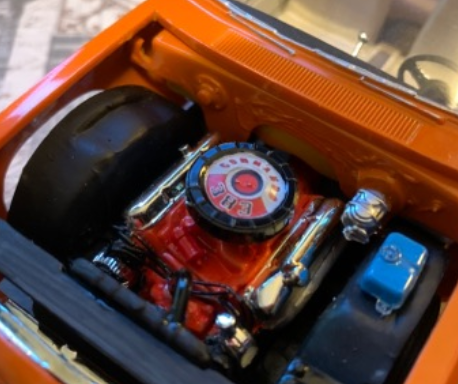
I really love/hate this engine. The shaker is mischievous and is completely Vader-esque once you remove the hood. However, after working to make sure the wires are right, the engine is perfectly painted correct hemi orange, and the radiator hose is hooked up in the right spot, you are unable to see anything but the massive “hat” on top. Basically, the Hemi is a monster hidden under a cloak of hiding and it sucks. Don’t misunderstand me, if I purchased a ‘Cuda, you can be sure I’d get one with a shaker… but there is a rather large difference between 1/24th scale and the real McCoy.
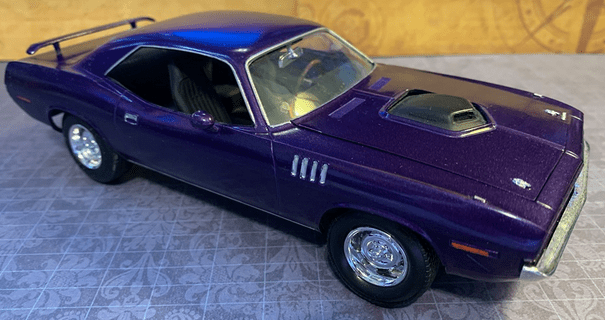
This fish needed to be purple. I really detest the Plum Crazy paint Testors makes, so I used the Testors Purple-icious paint instead. It is very close to the 70’s In-Violet and is a much easier paint to use than the other one. There are a lot of fine detail chrome to do, but I patiently got em done. I don’t like the hood fit and as I said before, the exhaust fitting through the body is annoying. I also decided to not use the “billboard” Hemi decals. I’m not a big fan of them, but the black decals look terrible against the purple. I could’ve made white ones, but decided against it.

Like other Revells, this one is fairly well detailed. I went with the flat black interior with wood accents. Pistol shift, rear mirror, and directional stalk were standard equipment.
The underside of this one is like most Revell Mopars as well (no pic). Tight fitting wheels, nice detail, and nothing out of the ordinary. Aside from the exhaust (which is getting exhausting to mention), you’ll like this one. Speaking of this subject, the tips are – IMHO – smaller than they should be and aren’t chrome (sorry.. paint is NOT the same thing).
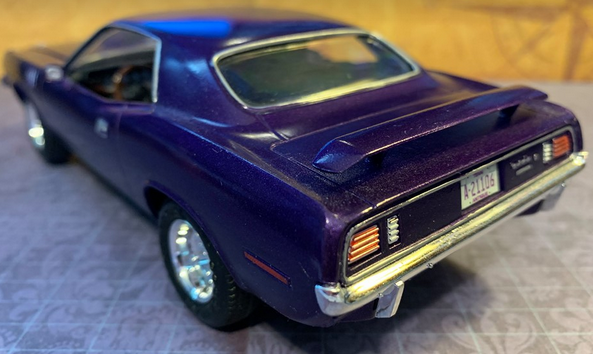
I can say that I really like this model. I can also say that it is NOT the easiest of models to do properly. They are slowly climbing in price (somewhere between $20 and $35), but they are also everywhere and in many forms. There are also a slew of 1970 Barracudas as well, so even more to choose from. NOT a good investment, but like the notoriety of the car itself, it is a popular model.
8.75 – Very Good
’76 Ford Gran Torino
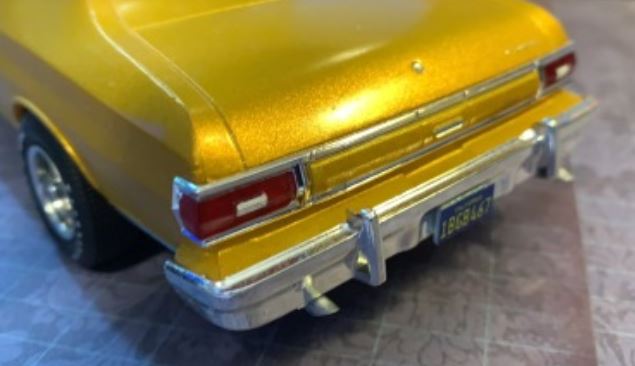
This is a review of the Revell 1976 Ford Gran Torino kit# 4412
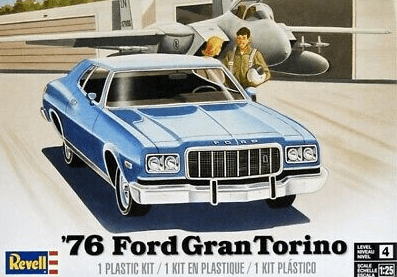
I was into a LOT of 80’s shows when I was little and most of them centered around cars. Hardcastle & McCormick, Dukes of Hazzard, Knight Rider, Magnum P.I., Automan (I’m sure you’ll have to google this one), and, of course, Starsky & Hutch. Now, the last one was probably my least favorite, but it wasn’t because of the car. This kit is tailored around the Starsky & Hutch police car used in the TV series, but it is also the swan song for an iconic muscle car.
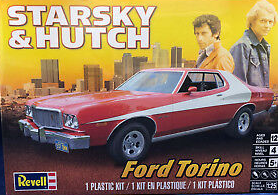
This is the only other kit for this year Torino and it is molded in a vomit-inducing red-orange. The secondary pieces are all in black and the chrome is – chrome, but has the red “tint” that chromed color pieces typically do. Both kits have the decals and police light for the S&H version, so you are just gaining the “box” as a collector item vs. the other kit.

CAR BACKGROUND :: By the mid 1970s, the “muscle car” era was completely dead. There were a LOT of wannabees that tried to carry the torch – Volare Roadrunner, Trans Am, Mustang II King Cobra,… and so on, but none were as fast as the earlier cars were. By the start of the 80’s, cars were more about gas mileage and looks than speed. The ’76 Torino did fit the mid-seventies cliche’ perfectly though. With a 351ci engine pushing out a wheezing 152hp, the ¼mile would take almost 17 seconds. The fast and nimble Torino was no more.
BUILD NOTES : So, back to the model. It is a really decent build. Most of the parts fit reasonably well and there isn’t a lot of flash to remove. You have to watch for the two pieces just behind the front bumper as they should be glued on before painting. There aren’t a lot of “extras” with this one, but it isn’t a 2-in-1 or street rod either.

Well it may be one of the least powerful engines you’ll see on my site, but it is rather attractive. The engine bay is detailed ok, but the engine looks really smart. I added a chrome air cleaner and made my own 351 decal. I also added a caution fan decal, but otherwise the rest looks fine. If I were looking for this to be a drag car, however, there is enough room to stuff in a 428CJ or the like. Just be aware that all “street” parts will have to be from your own parts bin.
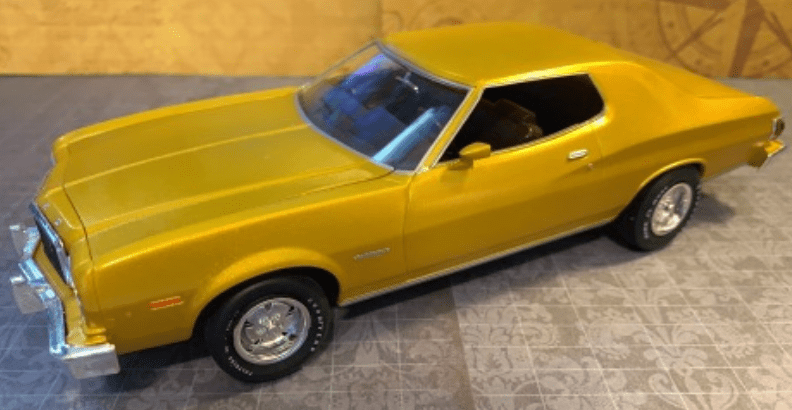
Since I purchased the non S&H version, I was able to go with a Inca Gold motif (close to the stock Ford color). I like this color a lot on the Torino and the brown interior matched well. I used white letter tires and rims from a ’71 Mustang as the regular hubs looked terrible (and old-man-ish). Bumpers fit easily and I like the way the under-carriage fits into the body – rock solid.

I decided to go with a brown leather look and it looks good with the gold. The automatic stalk was removed and I replaced it with a 4-speed stick shift on the floor. Won’t make the car blazing fast but burn-outs are a bunch easier. The rest of the interior is very detailed and has everything – including a directional stalk and rear-view.

I wish most model cars looked like this one underneath. Great detail, easy to work exhaust, and easy-as-pie fit to the body makes for an A+ all the way around. I replaced the stock “tips” for some larger, more prominent ones, but otherwise, you’ll need nothing for this one.
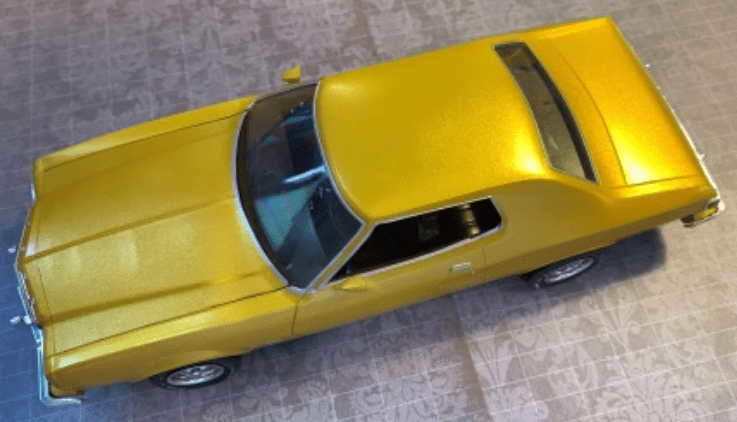
Beyond the really bad muscle behind this muscle car, the model is really, really good. The decals are there for the Starsky version, but for the regular car, there is enough to be happy with. This is a top-notch collectable too since it is the first run for this one. It also means that it is very affordable. Hobby Lobby has them for $18 after 40% coupon. If you want a really good, inexpensive builder… this one is IT.
9.5 – Excellent
2020 SCALEMODELING CONTEST!!!
Hello all!
I started this blog/info website in June of last year and I have had some good success reaching modeling fans. I have yet to see a “like”, “comment”, or suggestion from anyone… so I am therefore going to sweeten the pot. I will be looking at the website for a full month and I will choose someone at random to receive a Model Car gift package!
This contest will run from 1/10/2020 through 2/10/2020. The winner’s post will be displayed on the website and I will send out a FREE gift package.
The package will include the following ::
- One complete engine
- One tire set
- One rim set
- Two sheets of decals
- One Testors Spray Paint
- One package Testors brushes
- AND.. A GIFT CARD!
There is no purchase necessary; no number of times you have to post; no favoritism for “good” or “bad” posts; and no “post to Facebook” B.S. I would like to get repeat fans, interested modelers, and hopefully hear some feedback for the work I do here.
GOOD LUCK AND CHECK BACK ON THE 20TH OF FEBRUARY FOR THE WINNER!
———– kEVIN.
’70 Plymouth Roadrunner Superbird (Hemi)

This is a review of the Revell 1970 Plymouth RR Superbird kit# 4921
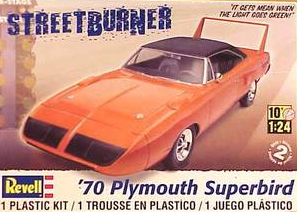
This is the first time I tried to make this model. Many years ago I tried to make an AMT Daytona – Superbird’s brethren – and… let’s just say it didn’t get very far. The AMT was NOT a good kit and I was much less experienced to work it. I HAVE always wanted to do one though since they are one of the most expensive, and famous muscle cars of the era.

The above kits, save for the Jo-Han, are all the same animal. I have not seen the “Richard Petty” version, but I assume you can still use the same decals as the others. Most are in the same price range too, but the Jo-Han is otherworldly priced due to rarity (I would guess). Revell also made a 1971 Roadrunner Superbird model, but I cannot speak to its quality. It also seems like it is molded in yellow.

CAR BACKGROUND :: The Daytona was created specifically for NASCAR in ’69, and for ’70, the Roadrunner was given the same treatment. Having used a wind tunnel (first in American history), the 2 cars were as smooth as a boxy muscle machine could be. The aero looks weren’t just for show either as the cars were equipped with both the 440ci and 426 Hemi engines. Though using the same engines as the ’70 Roadrunner, the Superbird was actually a tad slower in the ¼mile due to the heavier curb weight. That said, the ‘Bird could still fly through the traps in less than 14 seconds at over 100mph. More than this, however, the Superbird was much more stable at speeds over 70mph due to the aerodynamics and would likely been an entirely different car at speeds over 100. What a marvel.

BUILD NOTES : As I said before, the AMT Charger Daytona is a lousy build. Worse than the Charger kit they make, and even worse than the REALLY bad Dukes model they have. This is a tremendous kit – in comparison. The nose fits well, the tail wing has pre-drilled holes, and the finish is just plain better. The decals are typically good quality and I cannot think of a big problem with the kit. There are very few “street” parts, but this isn’t a good car for “hot-rodding”. There are enough parts and decals to make a “Petty” stock car, but that isn’t my bag. On that note – the decals for the NASCAR are also a bit B.S. as they include 426 c.i. decals for the hood and the kit ONLY includes the 440-6.

Didn’t I say this kit doesn’t come with a Hemi and yet here it is? Well, unlike most kits I build, I decided to give this kit a needed upgrade. This kit – and I believe all Superbird kits – comes with the standard 440-6 engine. This bad-boy has a 426 Hemi nested inside. This 426 is out of a failed Revell kit and fits PERFECTLY in this car. I affixed a Hemi decal I made and wired it properly. Like most of the Revell kits, the firewall stinks and I added a wiper motor to help it. The battery and washer bottles are both molded into the body of the car – so tougher to paint properly as well.

This model’s engine bay is also slightly flawed since the washer reservoirs aren’t the same as the real one (pic right). I think the 2-bottle setup is from the ’70 Roadrunner that Revell makes and they just transferred the same body over to this kit. Since the pics, I have detailed the radiator and battery as well. I love me a Hemi, but love it more in the Superbird… it just fits.

This car is painted Big Bad Blue – an AMC color that very closely resembles Corporation (Petty) Blue from 1970. I added the front light and back panel decals and added my own Roadrunner Superbird decals on the rear wing (as they weren’t included). Because the top was textured, I went with a black vinyl look. I really like the fit and finish of this kit – save for the hood. It took a long time to bend it enough to fit it flush and it still isn’t as perfect as I’d like. This is a LONG model as well. At 221in (real life), this car is as long as a ’72 New Yorker, and with 1/24th scale, is just GIANT.

Like most Revell Mopars, the interior is well detailed. I went with straight flat black and pistol shifter. I forget if I had to add a directional stalk.. I don’t think so. Rear view and side mirrors are included, however. It is also 100% better than the AMT Charger’s interior… dreadful.
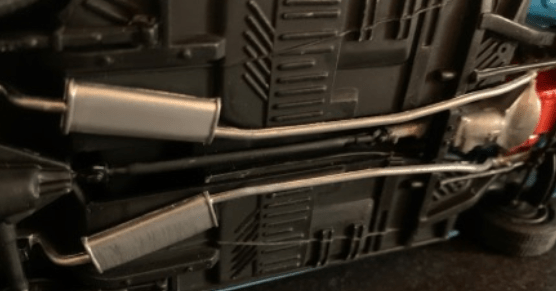
You’d think the bottom would be a wreck with the non-stock engine… and you’d be mistaken. Because both are Revell, they match up rather well. The remainder of the bottom is very much Revell goodness. it is well detailed and the axles/wheels work fantastically.
This model is just great and is only lessened by the decals and lack of engine choices. In any event, you have one of the better models made AND one of the better muscle cars. It is starting to become a good collectable kit as well. The prices are already on the rise and they are getting harder to find by the minute. Better get one while you can still afford it. You surely can’t afford the $165,000 for the real thing, anyway!
8.75 – Very Good
’69 Plymouth Barracuda

This is a review of the AMT ’69 Barracuda from ’69 Muscle Car Superset
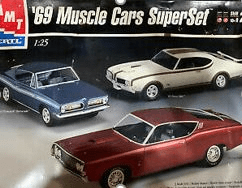
I have made this car a couple of different times and I swore I’d never fool with it again. Well.. here we are. I needed to buy the Torino more than once and these “sets” are cheap for three cars. They are definitely problematic, but cheap. I wish I could say this is a good kit, but…
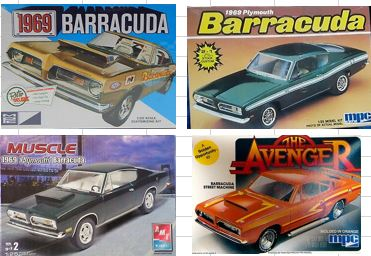
The above kits are all of the same “goodness” and that is to say MEH. The only one of the bunch molded in color is the “Avenger” – and it is a brilliant orange. The “gold” one above has fantastic decals, but the rest have the same parts bin.

CAR BACKGROUND :: This Cuda body style was hitting its stride in 69 and was ready for a complete re-do. That said, this is a very sharp car. The fastback, full-width taillight w/back-up, split grille, and short stance made for a very coveted muscle car. The 383 wasn’t half bad too. At 335hp, the little Cuda would run the quarter right around the mid 14s.
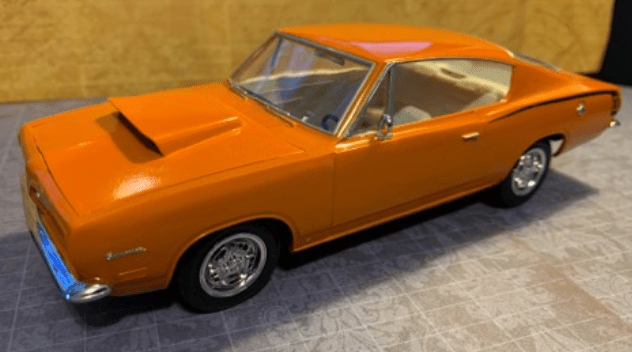
Like I said above, I have made/tried to make this car a few times and for the most part, it is a POS model. This time I went with a bright Tangerine craft paint and it looks good – if a bit brighter than the ’69 original paint. I used the stock rims, but went with better tires from another kit. I also went with the hood scoop since the rest of the hood doesn’t fit well (something else to look at). I had to add a side mirror (off a 68 Roadrunner) and I made the 383 hockey sticks because the ones that come with the model were too wide. There is also something missing completely from this car – backup lights. If this IS a true ’69, there would be backup lights on either side of the plate. So… I could have left it as a ’68 or added rear lights. I added the backup lights, but I half wonder if this should have been a 1968 kit instead of a 1969?

Usually the AMT interiors leave a bit to be desired, but this one is fairly decent. The black and white really helps, but it is also better detailed than most. I had to add a directional stalk and changed out the lousy gear shift. I think I had to add a rear view mirror as well. This is definitely a “parts-bin” kind of car, but the interior especially needs all kinds of help.
The engine bay is a bit of hot-n-cold. The firewall doesn’t quite fit, the detail is low, the radiator is flat, and the battery is crap. On the upside, the engine has good detail; I added some nice pieces; and I created an original “383” air cleaner decal.

The underside is AMT-typical low quality. The exhaust is part of the bottom and has no “tips”. The axles require metal pins and there are no extra parts. Even the axles are hole-squares that attach to the sides vs. being separate pieces. It is simple, easy and boring.

These kits are everywhere and even though it is a less-than-average kit, it is still a nice car and can look great with some help. It was just reissued so not a fantastic investment kit, but building is the key anyways. Definitely not for the novice, but for $20 a pop, you can sure get in some practice.
6.5 – Mediocre
’69 Dodge Super Bee 440-6

This is a review of the Revell ’69 Dodge Coronet Super Bee kit #2363

I can remember some thirty years ago being at my best friend’s house (Kevin Randall), and seeing his Coronet 440 model he had put together. He hadn’t painted it but instead used one of the metal flake ones instead. The rest of the car was awesome. I coveted the damn thing – to the point of offering trades for ANYTHING I had. Well, years later, I decided to do my own and this was the kit I chose. This IS the only kit I am aware of that doesn’t come with the blue/metal flake molded. It is a substantial kit with a ton of solid pieces.

The above kits are are pretty much all the same and they are very good – save from the molded color. There are also a couple of older/antique ones out there, but these are the bread-and-butter ones you’ll find and at 1/5th the price.
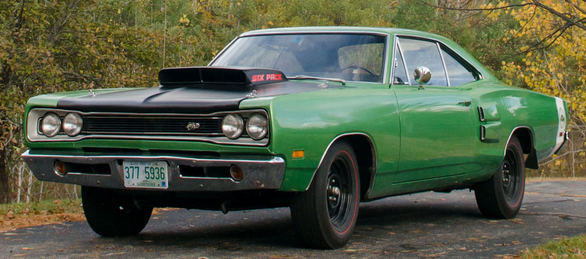
CAR BACKGROUND :: The Dodge Coronet had gone through a bunch of changes from its inception, but 69 brought it closer to the Charger’s look than any other year. Bigger, and bulkier than the Charger, the Coronet was still a capable mover in its own right. The A12 (pictured here AND what I modeled mine after) was a rare option for ’69 that included a fiberglass hood, 440 six-pack V8, suspension work and more. With this setup, the Coronet would rush through the quarter mile in under 14 seconds at over 100mph. More than that, the car looked amazingly evil with the new colors and stripe sets available.
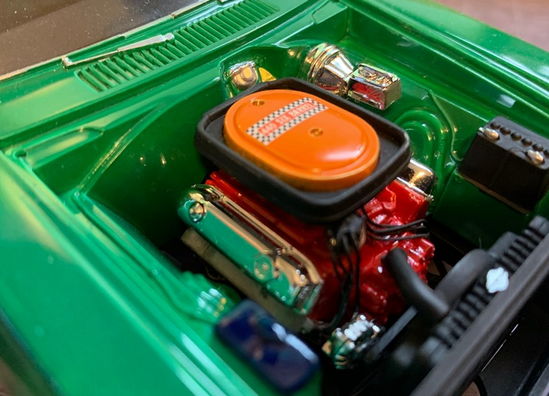
Well, here is the beast. A wired and ram-aired 440 six-pack. This engine bay – like most of the Revell Mopars – is very well done save for the firewall (a tad barren). The 440 decal works very well on the smooth air cleaner and it looks good slightly raised. No extras needed either, which is very refreshing.

I’ve only made this model one other time, and though the paint came out nice, the top took damage from too much glue toward the top of the windshield. This one is painted Clover Green – a craft paint that works well most of the time – and closely matches the original medium green. The hood is flat black and I used the Super Bee stripes included. Bee careful with the bee stripes as they need the side-marker holes cut carefully out before applying. It is something not realized until you try to affix them and there is a film over the lights.

I really like the Revell interiors that they use for the 67-70 Mopars. They just have a lot of detail and are rarely problematic. This one is the usual flat black with a wood steering wheel. I don’t remember if this one came with this shifter or if something happened to the pistol-grip one. I’d rather have the later, but oh well. Rear view mirror and side mirrors included, BTW.

The toy my friend made above WAS missing something like this one did. Exhaust tips. The kit comes with a nice exhaust setup that attaches easy to the engine and is a one-piece with the axle. However, the ends of the exhaust look fake and lousy, so I added chrome ones. The remainder looks great and there is a lot of extra detail.
This kit is still somewhat easy to get and the price is reasonable ($22+) as long as you don’t need the older collector’s edition. And, honestly, it much better than spending the $80,000 plus for a REAL A12. It also would be a good one to collect since it hasn’t been reissued as of late.

9.25 – Excellent
 The Model Car Showroom